- Francais UPU language
Showing posts sorted by date for query upu. Sort by relevance Show all posts
2022-07-17
2022-07-04
Chiosonne

Chiossone arrived in Tokyo on January 12, 1875. In the
same month the machines ordered arrived in
Yokohama.
From 1875 to 1891
02.01.1876: Completion of eight original dies for then
Koban-stamps with nominal face value from 5 Rin to 15
Sen, Michel-Nos. 40 - 49 (Sakura Nos. 61, 62, 64, 67-
73).
07.03.1876: The bloc-of-four-die of the 5 Rin design
had been amplified 20-fold to form a die of 80 stamps
to produce corresponding printing plates.
17.05.1876: The first relief printing stamps of Japan,
Koban 5 Rin, 1 Sen and 2 Sen (Michel-Nos. 40 - 42;
Sakura Nos. 61, 62, 64) had been issued.
26.07.1876: Completion of the dies for domestic postal
stationary cards of 5 Rin and 1 Sen in Koban design.
Michel-Nos. 40 – 49 // Sakura Nos. 61, 62, 64, 67-
73
19.09.1876: Issue of the first two postal stationary
cards of 5 Rin ochre and 1 Sen blue in relief printing.
29.06.1877: Issue of postal stationary covers in two
formats with Koban value imprint.
20.11.1877: Issue of the first postal stationary cards for
foreign use (UPU-cards) valued 3, 5 and 6 Sen.
The balance of his philatelic activities in the
Government Printing Office (insatsukyoku):
Stamps:
29 stamps within the period of 1876-92.
The two values of 25 Sen and 1 Yen issued in 1888 had
already been designed by Japanese.
Postal Stationaries:
Postcards: totally 20, covering 5 domestic postcards
1876-1888, 9 foreign postcards 1877-1898 (including 3
reply postcards). The total number includes 4 cards
with changed paper from 1892 and the two issues with
additional overprint "China" from 1910 using the Kobandesign.
Covers: one type "Koban-design with Guilloche-frame",
used for 4 different cover sizes from 1877-1888. These
four cards cannot definitely be assigned to Chiossone.
Sealing Stamp:
Official sealing stamp for foreign mails No. 1 with the
inscription "General Post Office of Japan".
The last stamps of the old Koban-issue appeared on
October 11, 1879. Afterwards, Chiossone didn't create
any more dies and plates for postal purposes.
Plates evolved from 4-pos cliche to 80-pos plate, 100-pos plate , and 400-pos plate
2022-06-07
Universal Postal Union ... 01.06.1877
Japan joined the earlier General Postal Union, 24 members ... In 1875, UPU was created. this year marked the beginning of the IJPO foreign mail service ...
the negative cross is from a 25 year UPU official IJP document. incidentally, the spiro koban sheets, act as ambassadors of the postal reform ... all the 5*5 sheets bear YH75 botas, and nodate-roman letter indicia ... the negative cross, predominates as a bota in the various imitative series ...
MAEDA Koban Botas - Yokohama
Maeda Botas appear on 45sen and other values ... same cancels on both Spiro and Maeda. further evidence Maeda maker of early 1876 group... the killers lasted about 6 months, whether applied on mail or facsimile sheets
- rare cancel packet singles
- not 1 sheet has surfaced (UPU)
2022-05-28
JPS 2008 cancel guide ... section 2234
bryan's 58 killers ...
the IJPO joined the UPU in 1875, in hope of solving common problems of international mail seapost. at the beginning of meiji era, several nations were active in japan mails - britain, france, usa, russia and germany... mails to other european destinations were carried by packet lines of these nations. the growth of railway lines internationally also speeded the mails overland.
to 1876, the IJPO domestically were using woodcarved indicia... duplex to cancel outbound, and nijumaru receiving marks. with the start of japan's foreign mail service, things changed. the usa sold the pacific steamship company to mitsubishi steamship - the shanghai route was growing fast. this streamlined the US service to n america and europe. the british maintained a seapost route (twice daily) to hong kong and beyond. the french service also continued until 1900s...
roman letter daters and new obliterators appeared in 1875. the first set of killers were iron cast and manufactured by a NYC firm. Bryan brought these IJPO foreign mail office, where he acted as advisor. these appear above... historically these are important. compare each to designs in section 322 of the 2008 JPS handbook of japanese postmarks. the images below show original state. overtime, some degraded to only partial cancels. regarding the early roman letter thimbles, Bryan may have contracted these for IJPO also. I have yet to discover the source, however, they resemble more the british hong kong cancels of the time (perhaps a london firm manufactured them). ref: JP48-5
in 1875, tokio, yokohama, nagasaki, hiogo-kobe and hakodate were part of foreign mail service. by 1900, 44 japan offices had rubber-molded roman-letter daters. the JPA and IJPO offices in china and korea also moved to roman-letter daters as UPU requirement. the domestic letter botas continued to be made of wood - lasting about 6 months...
2021-12-11
SENF facsimiles from france ... c1890
Began selling “art supplements”•High quality, steel engraved facsimiles•No intention to deceive collectors –took measures to identify their work•Engraved markings into stamp designs•Dealers sometimes covered or scratched away identifiers to use facsimiles as forgeries
a colour-illustrated album page I acquired from france. it offers short sets to the 1888 1yen value koban ... it is a belle-epoch period piece ... on inspection all the images are art-repros or facsimiles ... a page from a senf -torres-schaubek album : (it exists as english edition also )
the copyists or graphic artists of the time often shared their work internationally, and assisted global distribution ... stamp packets were in demand. ultimately, the UPU became involved in arresting the products appeal amongst collectors ... the repros of withdrawn issues were deemed "forgery" under some national legal schemes. the artists vowed their art production was imitative ... non-postal forgeries and hence, not subject to prosecution. laws varied from 1 nation to another.
certainly, fournier of helvetia and maeda of japan - both had expert knowledge of postal history.
5sen brown is imperf, and of same design as the 5sen blue sheet image.
the kanji are simpler than maeda design. TORRES
2021-11-25
1877 UPU and spiro sheets ....
In 1877 Japan joined the Universal Postal Union, which specifies cooperative rules for international mail. ROMAN LETTER postmarks were mandatory ...
The UPU’s history can be traced as far back as 1863, when then United States Postmaster General Montgomery Blair called a conference in Paris, France, to lay down a number of general principles for mutual agreements, but delegates failed to agree on an international postal agreement.
Ten years later, Heinrich von Stephan, a senior postal official from the North German Confederation, drew up a plan for an international postal union, and upon his recommendation the Swiss Government convened an international conference in Berne on 15 September 1874. Representatives from 22 nations attended the conference, and on 9 October – a day now celebrated as World Post Day – the Treaty of Bern establishing the General Postal Union was signed.This treaty succeeded in unifying a confusing international maze of postal services and regulations into a single postal territory for the reciprocal exchange of mail. The barriers and frontiers impeding the free flow and growth of international mail had finally been pulled down.Membership in the Union grew so quickly that its name was changed to the Universal Postal Union in 1878. The organization became a United Nations specialized agency for postal services in 1948.
the spiro sheet facsimiles commemorate UPU and IJPO foreign mails
2020-04-27
Francois Fournier of Geneve ...
the predominant art-repro master was Francois Fournier ... based in Geneve, the home of the UPU; his newsletter le fac-simile reached a 25000 circulation ... the album presented over 4600 issues worldwide.
after his death in 1917, the remainder production was complied in sets with a backstamp "faux" .
his agent in france was named mercier, who predeceased fournier. the collection was likely an assembly of work from various graphic artists of the time ... some of maeda's work included. in japan, known catalogers were maeda and wada, takahashi a dealer also offered a list and album.
the late 19c catalog and album production was somewhat random ... the philatelic reporting was often based on rumour rather than fact . national catalogs, societies or academies were in nascent stages...
london, paris, bruxelles, berlin were philatelic centers ... all competing and trying to qualify and quantify stamp issues ....
I now regret disposing of my 1900 world catalog...
2017-12-11
2012-02-27
15sen /w denshin ... genuine or imitation ? "demmukyoku denpo chosa sho"
fig 1
fig 2
florian eichhorn replied ...
This 15 S. NK is a genuine stamp. The top left mark is a non-postal reddish-brown bisected circle. The bottom right black cancel is one of the "telegraph business telegram control dept." (demmukyoku denpo chosa sho ) which checked the telegraph forms for :
a. correct postage (and sued the senders in case, which had to pay the missing amount on special "telegraph supplementary charge forms".
These forms come in native and roman letter styles and are very scarce.
b. weak cancels and placed its marking in case. Shape is like an extra-large telegraph double circle. The text of the cancel is "demmukyoku
denpo chosa sho" with a period . in-between. A bisected circle with the same text was used, too. Both cancels were used simultaneously and
are uncommon.
There is also a large telegraph double circle with the text "demmukyoku dai1ka" or "telegraph business office No. 1 dept."
A "koban postcard blog" had a comment on it, stating the dept. was newly formed in 1891.8.12 when the "demmu kyoku" got divided in two sub-divisions, one "correspondence" and one "engineering". The former was the "telegraph business telegram control dept.", the latter a "electricity experimental dept."
A blog on telegraph double circles gives more details re. the administrative reorganizations, and shows more examples of this large double circle and also the bisected variant:
He also states:
- telegraph double circle style (large) latest known date 26.5.28 (1893, taken from the weak bisected circles);
- bisected circle style earliest known date 25.9.26 (1891)
The top row shows the well known small size telegraph markings with the inscriptions:
"naishinkyoku dai2ka" (domestic correspondence office No. 2 dept.) resp. "komukyoku ikka" (engineering office 1 dept.).
These are probably forerunners of our large double circle resp. bisected circle.
Stamp pictures with the large telegraph double circle:
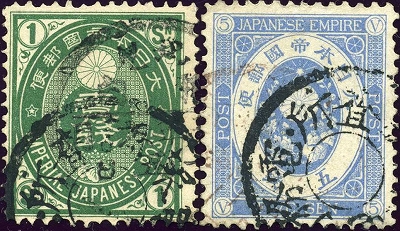
UPU koban 5 sen has the "demmukyoku dai1ka" inscription.
NK 15 sen has the "demmukyoku denpo chosa sho" inscription. Same as Your copy.
here I compiled a 100% cancel ...
Subscribe to:
Posts (Atom)
-
early litho 15sen with wada cancel ex KB1 Kam igata was not the producer of litho facsimiles attributed to him, but merely the publisher. ...
-
1874-1884 Ottoman Smolik, czech born national, was recruited by Uchida with Pollard to teach lithography method in japan. book publish...


.jpg)