2009-11-30
Welcome ...
2009-11-13
JPS : 2009 new monographs ...

2009-11-12
Spiro Plating Study ... on CD
A Plating Study : 1875-80 Spiro Koban Sheets
historically, little has been written to describe these woodblock koban sheets ... analysis of the 12 spiro koban sheets has revealed some interesting patterns ... I have compiled results with images and rationale. it is also a collectors guide, allowing personal plating study, with page and image templates ... an open-source living document .... included : pdf album pages for each value and anotated catalog of 300 positions... to enjoy the full experience of CD, be sure to download Picasa3 ... additional images on CD are not all linked in the study ... e.g., inverted blocks ...
recently acquired ... 1sen black B9 sec ... this has been appended . it demonstrates similar MXC /w L shift - compared to known sheet 001a.
2009-08-07
koban X ... imperfs
part of 1963 kelleher sale in the USA. being imperfs, they were described as proofs ... and appeared in seven colour trials ... a proper term is essay
clearly, both are 16 petal kiku as the known spiro sheets ... characteristics reveal they are closer to redrawn plate or retouched matrix ... MXC2
chiossone did send graphics to the Boston Expo, year ? can anyone provide more information on this series ... Boston and Genoa were "twin cities" ...
2009-08-06
modern repros and manipulations ...
a warning was posted in JP-isjp.org some years ago, mentioned that kobans exist with altered perfs, and fake mihon ovpts ... (never issued by IJPO). regretably, there was no followup, identifying which kobans were on the list ... a tokyo group was the source.
caveat emptor : beyond the imitation series, some skilful alterations of genuine issues or "gizu" exist ... follow the latest JSCA tables closely, and seek expertization when required ...
hopefully, the JPS expert committee will offer new advice to collectors.
2009-07-22
the floating world ...
the study of koban imitations is fascinating ... in time, I hope to achieve original prints of the various designs, with their original designed MXC or cancel matrix.
compared to the ISJP CD on forgeries of 2002, this new outlook should prove rewarding ... the focus, changes from plate-position-state ... to the overlay plate of indicia.
the contibution to japanese philately by woodblock artists cannot be underestimated ... most of the indicia were hand-carved from boxwood or pine, some bamboo ... also the dragon and cherry blossoms were acid-etched 40 position plates ... medium changed from cherrywood to wax-coated copper sheets ...
2009-07-12
Enkakushi - Genuine and forgery
| From Japanese kobans 1876-92 |
300 copies of genuine Enkakushi were produced in Japan for diplomatic use ... most residual copies were destroyed in fire that followed 1923 Earthquake. the enkakushi depicted all genuine japanese stamps to date of issue. Kristian Wilhelmsen noted that special plates were made for 1871 dragons as supplies were exhausted, and withdrawn prior to 1896. so these are the rarest of dragons ... I term these "laughing buddhas" ...
the negative image speeds plating in 8x5 matrix.
,
Wada Kotaro followed with a facsimile edition... ISJP Index to JP, reports dates of 1896.3 for genuine and 1896.10 for forgery editions... Wada not having produced any koban forgeries of his own, thereby recruited and included the Maeda series unused in his compilation... fewer copies exist today of imitation enkakushi, than genuine - seldom seen at auction - both command high realised values...
the fact that some genuine postal stationery was included in the facsimile enkakushi, forced the IJPO to seize and destroy most ...
2009-07-10
future CD projects ...
the library of grouped indicia or cancel slugs is advancing moderately... my active study beyond the spiro sheets , includes two basic groups: bota and nijumaru, or double circle. bota subgroups : the foreign seapost , and letter cancels. these will be classified according to the latest cancel monograph of the JPS 2008 ed. ... this will allow collectors to separate the woodblock reproduction series from the genuine kobans.
nijumaru subgroups : the partial cancels (90 or 180 degree) ; inter-value correlation analysis; ... and the free-form double circles ... creating a new series of plated imitations ...
assistance from koban collectors and forgery enthusiasts is welcomed ... 600dpi-2x images please .
2009-07-09
tourist sheets of japan ... ISJP

Ron Casey , now editor of JP has compiled information on the source of koban forgeries of Japan in ISJP Monograph 17 - a study of "tourist sheets" ... a masterful work ... finest research, chronology and printing ...this is the best companion reference to ISJP V2 CD on forgeries, no doubt ! anecdotally ... the world fairs' of 1900 in Paris and London - "Crystal Palace", were largest sales of these items... Ron reported 50000 sheets ordered for Paris fair alone (Gely) ...the global popularity of tourist sheets - was due to scarcity of early period covers and adhesives of Japan; sought by foreign philatelists ... no IPO foreign service operated until 1875. the foreign treaty POs carried the seapost. plus the fact that "double-envelope" system 1871-1875... precluded any IPO signatures abroad... only domestic mails....as copyists in Japan, Maeda and Wada recaptured this era of postal history in a most imaginative and artistic way ... or "floating world"
2009-06-07
genuine and imitative kobans
Kobans and the JPS ...
Japanese philately has changed more in the last decade than decades previous ...
The internet and new philatelic tools - the ability to scan and relay images to other philatelists; has assisted both research and the auction business greatly. JPS members are very active in this area, and many revisions to the specialised JSCA catalog reflect this today. ... the specialised series in now in 3 parts ... classifications have been augmented, restructured and many new varieties have been detailed.... any serious koban collector follows this system. Old Koban group : 80 or 100 position plates , whereas the Yu and New Koban group were 100 or 400 position plates .... some die anomolies are detailed in the JSCA catalog - allowing separations of 100-400 plates ... perf variations : comb to bickel perforator.
the JPS members also author specialised mongraphs ... these are Japex introductions, and are all expensive to acquire. a new plate guide is available for HES : narumi press co ...
Koban Forgeries and the ISJP...
Relative to the dragon and cherry blossom issues 1871-75, which have been heavily forged or imitated - identifying koban forgeries is an easier task. For novice koban collectors, coverage is primarily the Old Kobans 1876-80, which predate the UPU and New Koban series to 1892. ... some new koban varieties , exist imperforate ; and are likely stationery cutouts... caveat emptor for 6sen, 12sen, 30sen and 45sen denominations however... some very skillful "unsigned" forgeries exist - sanko or "signed" forgeries are online @ the isjp.org ...
Again, the monograph on Japanese Classic Forgeries 2002 edition is a key reference for all... allowing an audit of personal holdings; and advice regarding acquisitions of new material from auction or dealers. Many houses today still post obvious forgeries as genuine stamps. ... ISJP.ORG site is superb ! you will find links to additions and corrections pages edited recently .... note also ... the isjp.org is offering a free service to members ... forgery objects will be reviewed via image scans provided via email transfer ... and a opinion rendered : forgery or not ..
also, here is a useful link to Hideo Endo's : Forgery Cancellations
2009-05-07
BPP expert marks ...
... the BPP in europe appoints experts for areas of philately...these marks or stamps were applied in the past to imitations or forgeries ...
this is no longer the case however... experts issue a statement : forgery or not. or a certificate if genuine is issued.
1 Eichhorn (current) 2 Kruger (to 1981) 3 Pape (to 1966) 4 Zweiling (to 1971) 5 Kruger (to 1981
these stamps are collectable, but damage the imitations unecessarily.
this policy of stamping imitations is followed by some online auctions today... hence, the goods are damaged before sale by amateurs or non-experts ... lowering prices realised. ... liability if genuine ???
latest JPS specialised catalog ...
various study groups and teams rigorously edit the sections and add new information ...
hopefully, in the years ahead a logicel or online edition will follow ...
google/translate is a great tool for exploring japanese language sites, blogs and auction ...
JPS new cancel guide ...


having worked with this guide for some weeks, I recommend it ....
the foreign mail section has been audited , bringing forward new indicia from the Nishino study ... for telegraph enthusiasts, this section has been expanded greatly ... the small double-circle cancels are a fine way to represent kobans ...
this is not a price guide : but aids research. I relate my koban imitation study constantly ... defining the imitation indicia.
2009-05-06
a time-series approach ... correlation of genuine and repro kobans
as time passes, more is known about the relationships between the artists, sources of the reproductions and their distribution globally... woodblock method is not unique to Edo period artists of japan, but continues today ... Varro Tyler, remarked that several european artists used this method, for reproducing many nations postal objects ... the japanese case, reflects none were "postal forgeries" during the classic period* ... further, various koban repros followed only after the genuine stamps were withdrawn from use (postal rate changes) ... in fact, this time-delay is signifigant ... Maeda Kihei emulated many genuine obliterators, nijumaru, denshin and even some maruichi cancel forms in his work ... botas reflecting both foreign mail and city letter-cancels also exist... (some are also "imaginative" or indicate "mozo" only)... note that Wada Katoro's son was president of the first philatelic club in japan ... the repro catalogs of this era are scarce ... so a goal was to recreate aspects of japanese philately, where none remained in japan proper or abroad ... foreign seamail postmarks as an example ... this is the function of copyists (graphic artists) : whether philatelic objects or other works of art ...
the work achieved by the ISJP.ORG and JPS members to date**; however, still leaves some "dead-ends" : or unanswered questions ... further, the original numbering of plates was achieved by K Wilhelmsen of Norway ... and the ISJP subsequently, reviewed the plates in the monograph - Kobans Forgeries of Japan : coauthored by Varro Tyler and Kristian Wilhelmsen.... the 2002 V2 CD on forgeries, follows this pattern today ...
in order to sequence koban reproductions more closely, I have started a correlation of each repro-object to dates revealed in Monograph 17, and to JSCA koban tables : date of emission, date of withdrawal of each denomination... repro obliterator or cancel form dates will be rferenced to 2008 JPS monograph on cancels ....each object, where possible is also cross-referenced to the isjp CD itself .... the cancel or obliterator, where it mimics the genuine should reflect a closer "time-series" of production for many of the koban repros... I am dveeloping these MXCs or cancel matrices overtime ....currently, the ISJP CD divides these as either "litho" or "typo" (engraved) plates as the original survey by Wilhelmsen ... my view is that all are woodblock design ...
assistance from isjp or jps members is invited ... scans @600dpi-200% can be sent as zip-files, or posted to google-picasa : albums (private or public) ... in the later case, please advise your URLs ...
* the enkakushi by wada, was a different case ... the IJPO seized most copies, as included were some genuine postal stationery items .... this was omitted from Casey's recent monograph on the tourist sheets. a definitive reference outling sources of classic reproductions ...
** 2008 JPS monograph on cancels , reflects this collaboration
2009-05-05
Koban trading ...
![]() |
| From Japanese kobans 1876-92 |
![]() |
| From Japanese kobans 1876-92 |
WANTED : koban imitations bearing any of the bota or double-circle (nijumaru) cancels forms shown ...
please send item scans 600dpi-2x images ...
stamptrader.ca@gmail.com
stamptrader.ca worldwide offers
HES imitations offered 1:1 ...
2009-05-04
separating kobans ... Picasa3
imitations were transferred by tracing method, then hand tooled producing irregularities in the frame lines. no orthogonality exist with imitations .... besides being askew... using metrics software I have discovered V/H variances between positions ... i.e. no standard size exist as die-cut letterpress.
picasa3 is a powerful graphic tool ... the continous zoom is superb, even in slide view. to verify a suspect koban, open the file image in picasa3 and apply the grid or straighten tool ... this will reveal anomolies of the frame box ...
compare image to that of genuine letterpress example ... and look for sanko marks ...
Tokio botas ...
| From Japanese kobans 1876-92 |
this is an example of a Meiji Tokyo bota and n3b2 nujimaru or double circle cancel ... a.k.a. duplex cancel ... during the early period of the IJPO the foreign mails were handled by a separate FMPO in the city ... in modern times, with routing procedures and labeling, substations in the tokyo district can now handle foreign mails ... the JSCA catalog features the above and a reverse image form of the bota ... surprisingly, the 2008 cancel reference does not go further ... many substations used the TB form as an obliterator ... on imitation kobans - there exist 2 cancel forms ....
Horst Mueller of Japan, is a lifelong koban specialist. we share a common passion ... Horst has hosted a site "Kobans" for many years ... within the bota section, he shows the many forms of specialised TBs ... do visit ...
2009-04-27
5rin imitations ... warning
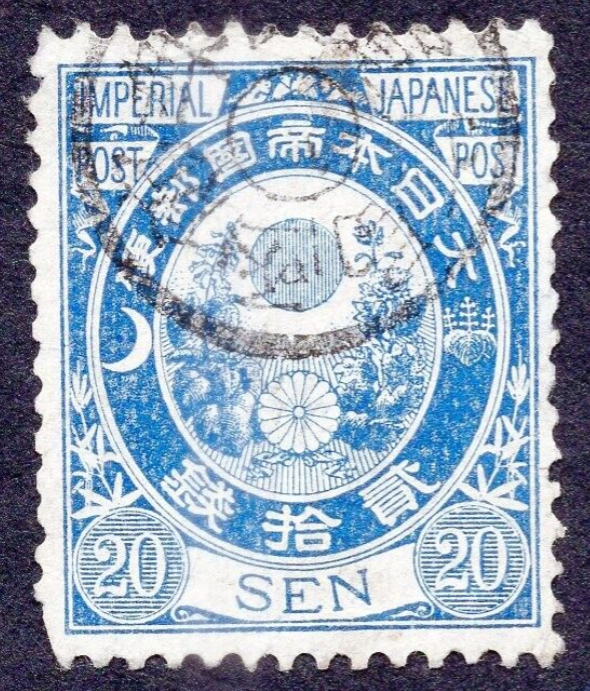
Wada Katoro did not produce any ... and Maeda Kihei has been identified as designer of one position grey-black koban ... however, looking at the 25 position spiro sheets : 3 16-petal kiku sheets exist ... that I would class as troublesome to the collector ...
close examination of the kiku design , and comparison to the genuine is required ... on the left is a spiro-kiku; on the right a genuine-kiku design. in the imitations, normally a dot appears in the core ... also the petals are mishapen ...
note the variance in the oval frame designs ...
origin of spiro sheets ...

the CD project reflects 12 spiro sheets, or 300 positions. the woodblock method has been sucessfully decoded and further sheets will surface in time ...
all are japanese origin ... past literature stated these were the work of Philip Spiro of Hamburg, DE . however, he disclaimed he was maker; only a dealer-distributor ... his dealings began 1864, and ceased in 1880. the golden era of facsimiles by international graphic artists...
my view, is that all koban reproductions or imitations are the work of one artist - Maeda Kihei
Spiro plate cancel matrix : MXC

unknown 5sen spiro sheet....
the 5sen brown is from an unknown spiro sheet ... the cancel just touches on the upper frame ... this shows clearly in the negative image ......analysis of imitations or suspect kobans follows ... starting with a 400pixel width image, having verified the "orthogonality" with Picasa tool, I form a negative image ... at this stage ... l@@k for tooling matrix dots in the design .... next, remove all colour, hue from negative ... to display the woodblock pattern ...
building a image library, will allow identification of items ... and plating of position in a matrix
Spiro koban sheets wanted ....
Spiro Koban sheets - 1875-80
Tom Zane recounts in the V2 ISJP CD on Forgeries, that historically Melville and Earee1, reviewed Philip Spiro's japanese imitations in the 19c philatelic press. ... currently the goal of my active plate study , is to qualify and quantify all positions in a nomenclature structure - or catalog system . ...known value-printings: 5rin and 1, 2 , 4 , 5 and 10sen sheets. ... these can be separated into 2 groups - type a : /w 16 petal kiku ; and type b : with 13 petal kiku ... further, within each value-group - separation characteristics are to be discovered ... unique to each plate ...
as the roman-nodate cancels and obliterators* are black ink random overlays of sheet production; these allow correlation analysis ... to date, many positions remain uncatalogued, so this points to volumous multi-layouts for all sen values. no doubt more sheets will surface in time ...
1875 marked the beginning of Japanese foreign mail service, so the 'jokohama' and 'nagasaki' no-date thimbles are an early projection of the genuine roman-letter foreign seamail indicia... published evidence to date, and anomolies of the romaji ... allow focus on a spiro-maeda-wada equation (early-middle-late periods)... and study may solve the true origin and matrices of the koban plates of "unknown" dimension ... (a.k.a. "litho" wada positions)... suppositions or hypothesis of this survey must be proven in time. ( Maeda Kihei of Japan ... a.k.a. Kamigata in V2cd ISJP on forgeries ... )
readers are urged to participate with any spiro positions from your collection : singles, blocks or entire sheets. ... please scan @600dpi-200% magnification ... a black vinyl stockcard is best suited for small lots... otherwise, if you have items for sale or trade, please contact me directly.
regards,
1. 22 were described in detail by the Reverend Robert B. Earee in the third edition of Album Weeds, How to Detect Forged Stamps.no orthogonality exist with imitations ... to help you identify spiro imitations ... visit the isjp.org

2009-04-24
5sen design ..
2009-04-17
the spiro-maeda-wada equation ...
any readers who own Kamigata tourist sheets, please contact me ... if possible I would like to acquire 600dpi-200% images of the kobans on sheet.
further inspection and analysis of the wada litho and typo series has begun ... I am using the deegam matrix as a guide to code the indicia ... these sets will enable extensions of woodblock slug blocks , beyond the ISJP 2002 CD. ...my view : value sheets (MXV) may be / are greater than 6 positions as spiro matrix (5*5) .... mxv = (3*2) ... (5*5)
2009-04-10
interim period : 1880-1890

my view : all are maeda designs : early-middle-and late period imitations ...
* imagine these were "interim-spiro-plate" production, not issued as sheets 5x5 : but as singles only
**the rarer maeda singles that appeared only unused state : are finer designed objects ...
2009-02-22
new view on koban imitations ...
the ISJP CDrom V2 2002 and Ron Casey's recent monograph 17 on the tourist sheets , both reflect the koban plates in an associative manner ... the evolution of the plates and their distribution methods ... the earliest koban imitations appeared in sheet format ... names associated with koban imitations are : Spiro Bros (1875-80) and later, 1893- : Kamigata (Maeda Kihei) and Wada Katoro of japan ... my study approach is intuitive: assuming and projecting woodblock design ... all are irregular trapeziods, handtooled .... so metal-plate typography is an unlikely method of manufacture .... the japanese government would have prohibited reproductions...
woodblock method - traditionally separates the designer from the marketplace ...the view of the artist, hence becomes sharper focused ... my personal investigation, treats all koban forgeries as : primitive-fine-very fine ... apprenticeship to master hikku... the development of drawing and carving skills and tooling improves over time ... commonalities between values also make me pose questions regarding production method and overlay patterns... for readers interested , David Bull , living in Japan delivers a fine account of woodblock method .
Universal Postal Union ... 1874-5
2009-02-21
References offered in trade ...
some feature Japan HES, others Hong Kong treaty ports ... the auction catalogs show many famous collections, /w full sheet images ... valuable for plating study.
2008-09-27
koban proofs ...
2008-06-20
restoration methods ...
PRINZ UHU Hinge Mark Remover is excellent for clearing paper adhesions and old hinges. Carefully applied with a fine brush, it can also be used to clear debris from mint stamps. It does not disturb gum surfaces. Be careful however, not to get solution on the stamp face itself. Other hinge remover solutions can react with inks, and should avoided. All red or crimson inks for koban are somewhat fugitive, so I buffer with fresh white blotting paper to printed side down.
The softer koban papers (JSCA C and D) should be cleaned only with shovel-nose stamps tongs, (smooth round surface towards the stamp); or a fine artists brush. Paper thickness can vary on given stamp, so again be very careful. Let these stamps soak longer in solution, before attempting a cleanup. .
Stamps can be placed in a Desert Magic drying book (blotter paper with vinyl interleaves).
As you work, note what is revealed. Vertical or horizontal wiremarks, etc. Place similar stamps in a group on a separate page of the drying book, or glass. Make copious notes of your observations; this speeds sorting later.
Avoid gum removers... If you have to rehabilitate a hopeless or heavily gummed stamp that is in danger of cracking, the PRINZ UHU Hinge Mark Remover can again be used to relax the paper and gum. Saturate stamp, then replace in either a hingeless mount or drying book until completely dry. Be careful as certain inks (reds) are unstable using this technique. Test first with damaged or faulty stamps.
Clean the watermark tray each time you use this method before moving to another stamp. This avoids depositing fine debris to other kobans. ... also spores that are the cause of "foxing", will not be transferred to other items.
Mildew stains and pencil marks can be removed with PRINZ UHU Hinge Mark Remover also.
For other products, read instructions fully, and experiment first with damaged or faulty stamps. Do not use with fully gummed stamps. Inks can diffuse...
Forgeries .... be very careful with 12sen koban ... rose colour is highly fugitive, and full saturation will weaken colour considerably..
also note, most forgeries arrive well-stuck to backing papers of different types ... ex "tourist sheets" or "booklets" ... thin, soft papers were used to print many dragon and cherry blossom F, so be very careful handling these ... fish glues are most tenacious ... use PRINZ UHU Hinge Mark Remover, and caution with tongs...
2007-09-21
scanning philatelic objects ...
2005-07-23
19c Woodblock Printing : Maeda's touch ...
- kamigata-e is an artform peculiar to his district in Japan ... posters and card production, some really fabulous creations... meiji print making is also described as the "floating world" ... david bull, a canadian in Japan defines the technique fully - and is himself a woodblock artist.
- the transfer method* applied to the imitations, suggested historically are : woodblock; lithography and typography (ISJP). - I discount typo and litho both: as presses were scarce in japan in 19c, and designs reflect woodblock method.
- *this becomes more complex in relation to the "matched" block and decal transfer method - cancel overlayered. ..."black-over-colour" is a japanese signature print-style of this era - as OP or overprint series ... "Masanobu multi-block technique" (Beguin) ...... the decisions a craftsman or artist makes as transfer method reflect his style and character ... link to Maeda's touch ... the palette reflects the design shades of kobans (small block) very well.
2005-06-17
Japanese printers - philatelic 1871-2005
- interesting site offering brief synopsis and historical perspective
- philatelic houses are listed here ...